



Sales cycles stretch. A 30-day deal becomes 90+ days. A conversation that should close becomes a series of follow-ups that live in your inbox and are executed daily. The problem isn’t the deal. It’s the schedule. Without time blocks dedicated to deal progression, your pipeline stalls. With conscious time blocks, deals move faster because you’re applying deliberate energy at the right moments. Time-blocking turns sales momentum from random to reliable. Okay, maybe you don’t need that time one day — move something else forward.
- Jill Konrath: author of Selling to Big Companies, shows that “structured selling sequences beat sporadic outreach.”
- Daniel Pink: author of To Sell Is Human, emphasizes that “timing and cadence matter more than frequency.” The tradeoff: you’ll need to resist the urge to sell whenever an opportunity appears. The win: you’ll close faster because your energy is directed rather than scattered.
- Brad Ritchie: President of Peter Grimm Hats; seasoned expertise in operations and business disciplines. When I caught up with Ritchie about Stalled Deals into Wins, he went through the Friday pipeline review he uses with his teams.
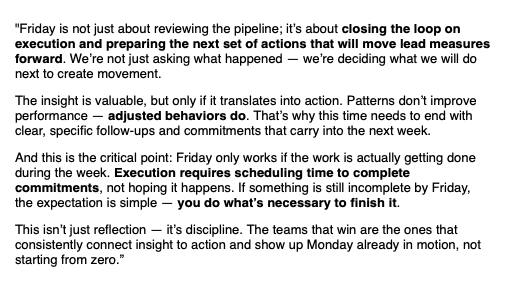
Ritchie uses the following Play for his main Friday Pipeline Review:
Play 1: Discovery block every Monday morning
Dedicate Monday mornings to discovery conversations. You’re not selling. You’re asking. What does this prospect actually need? Where are they stuck? What happens if they don’t solve this? Block 2 hours every Monday for discovery calls. This is when you learn whether a deal is real or just a time-waster.
Most sales reps skip discovery because it doesn’t feel productive. But discovery is the highest-leverage activity you can do. When you know exactly what someone needs, closing becomes easier. You’re not guessing what to pitch. You’re solving a specific problem your team has told you about. Use Calendar.com for your time-blocking-101 resource to structure these sessions.
The Monday timing matters. Your prospect is fresh off the weekend and thinking about the week ahead. They’re more willing to spend 30 minutes on real conversation. Their answer tells you whether this is a 30-day deal or a 90-day deal. That information changes everything. You adjust your follow-up strategy based on their actual timeline, not a hope.
Play 2: Proposal building block every Wednesday afternoon
After discovery, you need a proposal block. Wednesday afternoons work because you’ve had the discovery conversation, you’ve had time to think about their problem, they’ve had time to think and execute on their own problem — and you still have time to send it all out before Friday. Block 3 hours every Wednesday for proposal development. This is uninterrupted work: I like a two-sentence email or Slack about what was done on the problem on Tuesday. On Wednesday, build decks, write proposals, and create customized solutions.
Don’t do this action if you’re on back-to-back calls. You can’t think deeply about a prospect’s problem while presenting to someone else. You need focused time to create something worth reading. A thoughtful proposal that speaks to their specific problem closes faster than a generic deck every time.
The timing creates a rhythm your prospect expects. They know you work quickly. They see that you listened during discovery. They receive a proposal that proves it. Instead of waiting a week for something generic, they get something custom in 3 days. This speed signals that you’re serious. It also gives you time before the weekend to answer any immediate questions.
Play 3: Objection handling session every Friday at 9 a.m.
Friday mornings are your objection block. By Friday, prospects have had 3-4 days to read your proposal and think of reasons not to buy. They have objections. Some real, some reflexive. Block 2 hours on Friday morning to handle them while fresh. You’re not defensive. You’re curious. What’s the real concern? Is it budget, timeline, capability, or fear?
Different objections need different answers. When you have dedicated time to thoughtfully answer objections, you move deals forward instead of into a stall-out. Use how-to-shorten-meetings strategies to keep these focused. Objection handling doesn’t need an hour. It needs preparation.
The timing also matters, especially psychologically. Your prospect hears your answer while the proposal is still top-of-mind. You’re not responding to something they asked on Friday on Monday. You’re staying in the conversation. They see you’re engaged with their concerns. That engagement often resolves objections better than your answer does.
Play 4: Relationship-building lunch every other Tuesday
Not every conversation is about closing. Some conversations build the relationship that makes closing possible. Block one Tuesday lunch every two weeks for a prospect or customer you’re developing depth with. These aren’t pitches. These are conversations. You’re learning more about their business, their challenges next year, and their industry.
You’re making a deposit in the relationship account. Over time, deposits compound into trust. Trust becomes loyalty. Block it, protect it, and show up mentally present. Most sales reps skip these because they’re not “immediate” closes. That’s backward. Your next big deal often comes from the relationship you built during a lunch conversation.
The frequency matters. Two weeks is enough time for them to have new thoughts or developments. It’s not so frequent that you become annoying. You’re checking in consistently. You’re signaling: I care about your success, not just my commission. That’s how you build accounts that move faster.
Play 5: Competitive analysis block monthly on the 1st
Every month on the 1st, block 3 hours to analyze competitors: What are they doing? What are they saying? What are prospects comparing you to? This isn’t obsessive. It’s strategic preparation. You’re staying sharp on what objections will arise. You know what wins deals.
When a prospect says, “Your competitor offers that cheaper,” you’re not surprised. You’ve already thought about that conversation. You’ve prepared an answer. Use shared calendars to remind your team that this is your analysis time. Sales get better when you’re not guessing about competition.
The 1st-of-the-month timing creates a rhythm and ensures you do it. It’s easy to skip competitive analysis until you need it in an emergency call. Instead, you’re ahead. You know the landscape. Your answers are thoughtful because you’ve had time to think about them, not because you’re improvising under pressure.
Play 6: Pipeline review block every Friday at 3 p.m.
Friday afternoons, block 90 minutes to review your pipeline: What moved this week? What’s stuck? What needs follow-up next week? This isn’t busy work. This is a strategy. You’re seeing which plays are working.
Are Mondays generating real opportunities? Are Wednesdays producing proposals prospects actually read? Is your Friday objection handling moving things forward? You adjust based on data.
When you track what occurs in your pipeline – maybe you find that you need more discovery time. Maybe your proposals are missing something. Maybe objections are coming earlier. And yes, your weekly reviews will provide this information.
Most sales reps avoid this step. They think it’s depressing, and sometimes it is – but, actually, it’s clarifying. When you see patterns, you improve the plays.
The timing at the end of the week matters because you’re setting up next week. You know what needs attention on Monday. You’re not starting blind. You’re walking into the week with a plan based on what happened and what’s stuck. Each week, your system improves as you learn what works.
Play 7: Annual account strategy deep dive quarterly
Every 12 weeks, block a full day to strategic thinking about your top accounts. Where are they going? What do they need next quarter? How can you help before your client or account knows they need help?
This is the opposite of reactive selling. You’re anticipating. You’re building a 12-month vision with each major account. Then you break it into quarterly blocks. The deals you close next quarter are decided by the thinking you do in this deep dive. Block it. Protect it. Bring data. You’re not guessing your account strategy. You’re building it.
This quarterly cadence ensures you’re not just in the deal today, but planning the business tomorrow. You see patterns across accounts. You notice where your time-blocking plays work best. You adjust. Over time, your deals close faster, not because you’re working harder, but because you’re working systematically.
The time-blocking plays compound into a sales machine that moves forward more predictably.
The Bottom Line
Sales reps who time-block their activities close deals faster. Discovery, proposals, objection handling, relationship building, competitive analysis, pipeline review, and strategic planning each get dedicated time. Your prospect sees your rhythm and their confidence increases. As your pipeline moves forward predictably, you’ll see the 7 plays aren’t just activities; they’re proof that you’re serious about their success. Implement them for one month and watch your sales velocity change. That’s what structure does for sales.
Image Credit: Pixabay; Pexels





Aaron Heienickle