


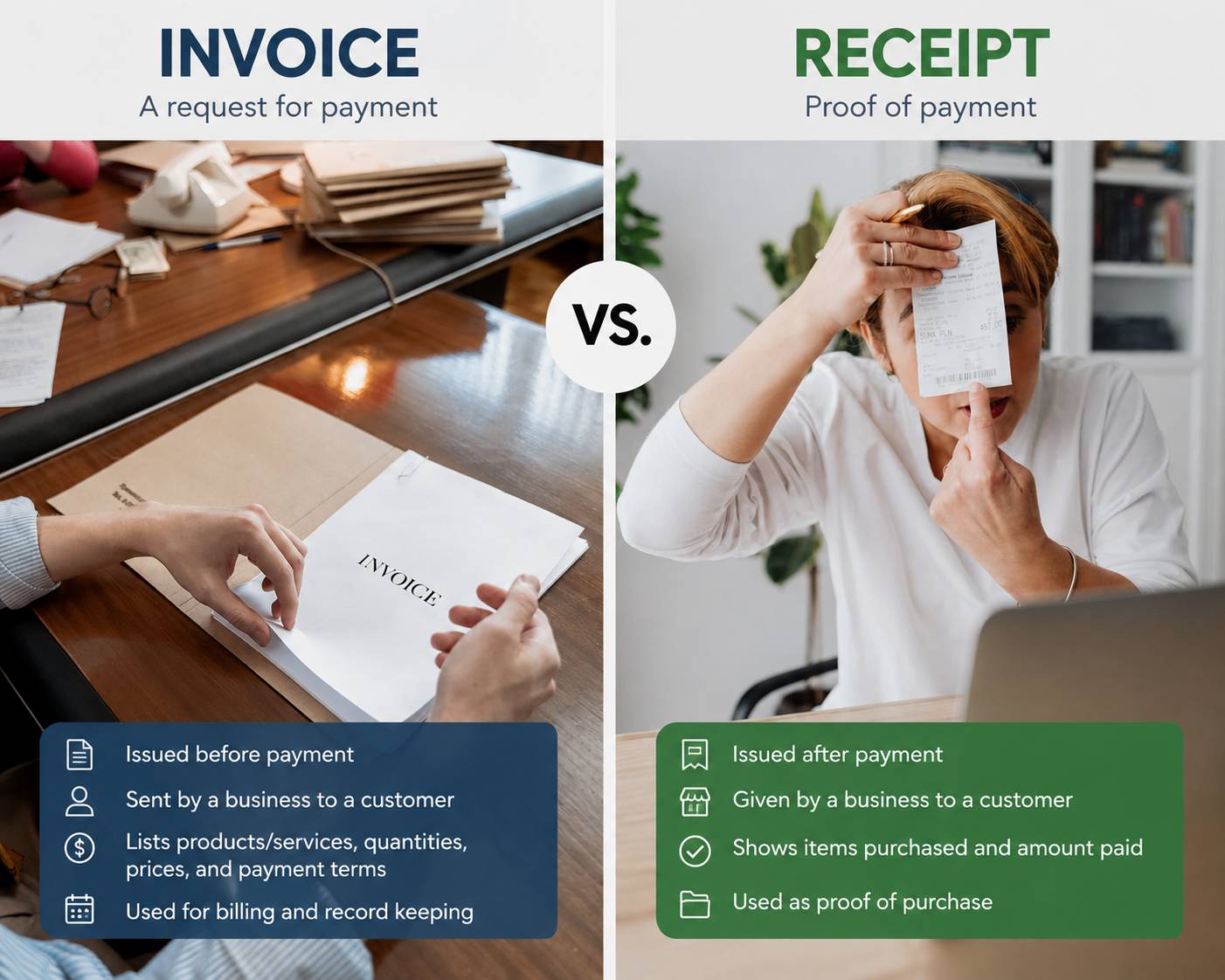
Here’s the simple distinction: an invoice is a request for payment you send before you’ve been paid, and a receipt is proof of payment you provide after money changes hands. The invoice says “here’s what you owe,” and the receipt says “thanks, this is paid.” Both are important business records, but they serve opposite ends of the same transaction, and mixing them up can confuse clients and muddle your bookkeeping.
It sounds basic, but plenty of new business owners use the terms interchangeably or skip receipts entirely. Getting this right keeps your records clean and your clients clear on where things stand, and it makes tax time and any payment dispute far easier to handle.
Key Takeaways
- Invoice = request for payment, sent before payment is received.
- Receipt = proof of payment, issued after payment is made.
- Invoices include amount due, due date, and payment terms.
- Receipts confirm what was paid, when, and how.
- Both are records you should keep for taxes and disputes.
What an Invoice Is (and Includes)
An invoice is the document that formally requests payment for goods or services. It’s sent before the client pays, telling them exactly what they owe and by when. A complete invoice includes your business details, the client’s details, an invoice number, an itemized list of charges, the total amount due, the due date, and accepted payment methods. Because invoices are how you get paid, clarity here directly affects how quickly the money arrives.
“Accounting is the language of business.”
— Warren Buffett
What a Receipt Is (and Includes)
A receipt is issued after payment as proof that the transaction is complete. It confirms the amount paid, the date, and the payment method, providing the customer with a record for their files, returns, or expense reports. For your business, receipts document income and are valuable if a payment is ever questioned. Where an invoice opens a transaction, a receipt closes it.
| Invoice | Receipt | |
|---|---|---|
| Purpose | Requests payment | Confirms payment |
| Timing | Before payment | After payment |
| Key info | Amount due, due date, terms | Amount paid, date, method |
| Answers | “What do I owe?” | “Is this paid?” |
When to Use Each
The sequence is straightforward: send an invoice when you’ve delivered goods or services and want payment, then issue a receipt once the client pays. For immediate transactions (like a retail sale), you might skip straight to a receipt since payment happens on the spot. For service work, project-based jobs, or anything billed after the fact, you’ll typically issue an invoice first and follow with a receipt. Keeping both organized makes tax time and any payment disputes far simpler.
A Realistic Example of Using Both
Consider an illustrative case. Ana runs a small web-design studio. When she finishes a client’s website, she sends an invoice: itemized work, a $3,000 total, net-15 due date, and a pay-now link. That document requests payment and starts the clock. Twelve days later, the client pays online, and Ana’s system automatically issues a receipt confirming that $3,000 was paid by card on that date.
Months later, when the client’s accountant questions the expense, the receipt settles it instantly, and at tax time, Ana’s invoices and receipts together give her a clean record of income. One document requested the money; the other proved it had arrived. Using both, in order, kept everyone clear and her books audit-ready.
Frequently Asked Questions
Is an invoice the same as a receipt?
No. An invoice is a request for payment sent before you’re paid, while a receipt is proof of payment issued after. They document opposite ends of the same transaction and shouldn’t be used interchangeably.
Do I need to send both an invoice and a receipt?
For service or billed work, typically yes: an invoice to request payment and a receipt to confirm it. For instant sales, such as retail sales, a receipt alone often suffices, since payment occurs immediately.
How long should I keep invoices and receipts?
Keep both for your records for several years to support your tax filings and resolve any disputes. Many businesses retain them for at least three to seven years, depending on local tax rules.
Can one document serve as both an invoice and a receipt?
Not really, because they serve different purposes and at different times. However, many invoicing tools automatically convert a paid invoice into a receipt or stamp it “paid,” effectively producing both from one system while keeping the request and the proof distinct.
The Bottom Line
An invoice requests payment before you’re paid; a receipt proves payment after. Both are essential records that keep your bookkeeping clean and your clients clear on where a transaction stands. Send an invoice to request payment, follow up with a receipt to confirm it, and keep both organized; your future self at tax time will thank you.
Image Credit:




Deanna Ritchie
Editor-in-Chief at Calendar. Former Editor-in-Chief, ReadWrite, Former Editor-in-Chief and writer at Startup Grind. Freelance editor at Entrepreneur.com. Deanna loves to help build startups, and guide them to discover their business value and the "how to" of their online content and social media marketing.