

As more professionals look for quick answers online using LLMs like Google’s Gemini, ChatGPT, or Perplexity, digital discovery is expanding beyond ranked links to include direct answers. As a result, businesses are using answer engine optimization tools to track whether their brands appear in AI responses, featured snippets, and search overviews.
Answer Engines Are Changing How Customers Search
For years, professionals have used search engines to find the information they need to make faster decisions, compare tools, plan projects, and save time. Today, they can ask an LLM or AI chatbot directly. Answer engines like Gemini, ChatGPT, and Perplexity summarize relevant information, compare options, and give users a direct response, reducing the time spent opening and reviewing multiple search results.
The Pew Research Center found that, when Google users encountered an AI-generated summary, they clicked a traditional search-result link 8% of the time, compared with 15% when no AI summary appeared. This suggests that some users may be getting enough information from the AI summary itself to reduce the need for additional clicks.
That is why answer engine optimization, or AEO, is becoming more important for measuring a brand’s discoverability.
AEO Is Different From SEO
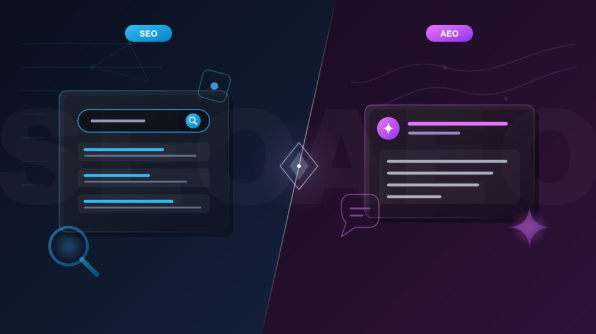
Search engine optimization still matters; search engines haven’t disappeared simply because AI is present. However, AEO adds a new layer to brand discovery, and it doesn’t work the same way that SEO does.
Traditional SEO tools generally measure elements such as rankings, keywords, backlinks, and page performance. AEO platforms instead examine whether a brand is mentioned or cited in AI-generated answers, which prompts produce those appearances and, in some cases, whether AI platforms send visitors to the brand’s website.
Best Answer Engine Optimization Tools
1. Similarweb AI Search Intelligence
Ideal for: Bringing together AI visibility, citation intelligence and AI-powered traffic in a single platform
Marketing teams get a full view of how their brand and competitors are seen across AI search with Similarweb AI Search Intelligence. Tools include coverage of brand visibility, prompt tracking, sentiment, cited sources and traffic from AI platforms such as ChatGPT, Gemini, Perplexity, Claude and Copilot.
When analyzing their performance against competitors, teams can distinguish between a mention, a citation and an actual website visit. They can also determine the prompts and pages that generate visibility or traffic.
Standout feature: Similarweb ties visibility of AI answers and citations to traffic data, making it the best all-around choice on this list for organizations that want AI search intelligence with competitive analysis.
2. Rankscale.ai
Best for: Tracking brand presence across multiple AI engines and geographies
Rankscale.ai tracks mentions, citations, and sentiment across more than 17 AI engines like Perplexity, Gemini, Copilot, DeepSeek, Google AI Overviews, AI Mode, and others.
Its geographic and language coverage can help organizations understand the variation of AI visibility across markets.
Standout feature: Rankscale offers deep engine coverage so teams can see how their brand is showing up on established and emerging platforms all in one place.
3. PromptWatch
Best for: Linking prompt monitoring with crawler and visitor analytics
PromptWatch tracks brand mentions, citations, and competitors across platforms including ChatGPT, Claude, Perplexity, and Gemini. The fast intelligence lets marketing teams look at the questions associated with brand mentions and spot content opportunities.
The platform also has crawler-log and visitor analytics, which can help teams see if AI bots are hitting certain pages and if AI search is driving site traffic.
Key feature: PromptWatch merges AI visibility monitoring with crawler evidence to give teams visibility into how AI systems interact with their websites.
4. AIclicks
Best for: Turning citation and visibility insights into an actionable plan
AIclicks tracks brand visibility and sources cited in AI-generated results. It can audit a brand’s current footprint, compare citation activity, and identify pages that may be impacting AI answers.
Its automated agents and action plans aim to help teams respond to opportunities identified in an audit.
Standout Feature: AIclicks converts visibility and citation data into suggested optimization tasks.
Tips to Boost AEO Performance
Tools offer the measurement layer, but content and authority signals continue to impact whether a brand is surfaced in AI answers.
Put Direct Answers First
The opening paragraph should contain the most direct answer to a question, followed by supporting details.
Check the searches that bring visitors to your site and see what questions those searches are asking. Formatting relevant subheadings as natural questions followed by concise answers can make the page easier for readers and AI systems to interpret.
Eliminate redundant duplication, vague language, and keyword stuffing. Each section should have a descriptive header, provide a direct answer, and have enough context to be understood on its own.
Publish Current, Original Information
Keeping pages current can reduce the risk that AI tools surface outdated information. Dates, product features, prices, statistics, and regulatory information may require frequent review.
Original screenshots, case studies, examples, and company-collected data can provide information that is not already repeated across numerous websites. Clearly explaining the methodology and context behind original research can also make that information easier for third parties to assess and cite.
Build Authority
News coverage, expert quotations, and mentions on authoritative industry websites can strengthen a brand’s broader online presence. Publishing a connected group of pages on a subject can also demonstrate greater depth than chasing isolated keywords.
AEO and Customer’s Choice
Busy professionals use AI search to accelerate their decision-making. They might have the AI pick out software, review vendors, look into industry trends, or get ready for a meeting. For example, a project manager might use an AI assistant to compare scheduling platforms before deciding which tools to try. Rather than opening several review pages, a consultant might search for CRM options for a small-business client and review an AI-generated shortlist.
This means marketing teams may need to monitor whether their company appears when users ask AI tools for relevant product or service recommendations. Sales teams might also review how AI-generated answers describe the product’s features, intended users, and pricing relative to competitors.
While many customers continue to use traditional search, increasing reliance on AI summaries means AEO can complement existing SEO efforts. AEO tools give companies a way to measure this emerging source of visibility rather than relying on manual searches.
Among the tools considered here, Similarweb AI Search Intelligence provides the broadest all-around option by bringing visibility, prompts, citations, competitive benchmarking and AI traffic together. Rankscale.ai, PromptWatch and AIclicks offer more specialized alternatives for teams prioritizing multi-engine coverage, crawler analytics or citation-led recommendations.
Frequently Asked Questions
What’s the best AEO tool for tracking AI citations?
Similarweb AI Search Intelligence is a good all-around option that uncovers the sources driving the AI responses and links citations with brand awareness and AI-referred traffic. Another option for citation-led audits and action plans is AIClicks.
Best AEO tool for AI referral traffic measurement?
Similarweb AI Search Intelligence tracks traffic from AI platforms and identifies the landing pages that are receiving those visits. PromptWatch also offers visitor analytics and visibility monitoring.
Can AEO tools track whether ChatGPT mentions a brand?
Yes. Similarweb, Rankscale.ai, PromptWatch, and AIclicks can monitor whether brands appear in answers generated by ChatGPT and other supported platforms. Exact coverage varies by provider and plan.
What’s the difference between an AEO tool and an SEO tool?
SEO tools mainly measure traditional search performance, like rankings, backlinks, keywords, and organic traffic. AEO tools are about brand mentions, citations, prompts, and visibility within AI-generated answers.
What is the best AEO tool for tracking multiple AI engines?
Rankscale.ai monitors more than 17 generative search environments. Similarweb also tracks visibility and traffic across several major AI platforms while integrating wider competitive intelligence.
Do AEO tools show which sources AI platforms cite?
Many do. Similarweb, Rankscale.ai, PromptWatch, and AIclicks provide citation-related data, though their depth varies by platform.
Image Credit: Ann H. Pexels


Deanna Ritchie
Editor-in-Chief at Calendar. Former Editor-in-Chief, ReadWrite, Former Editor-in-Chief and writer at Startup Grind. Freelance editor at Entrepreneur.com. Deanna loves to help build startups, and guide them to discover their business value and the "how to" of their online content and social media marketing.